
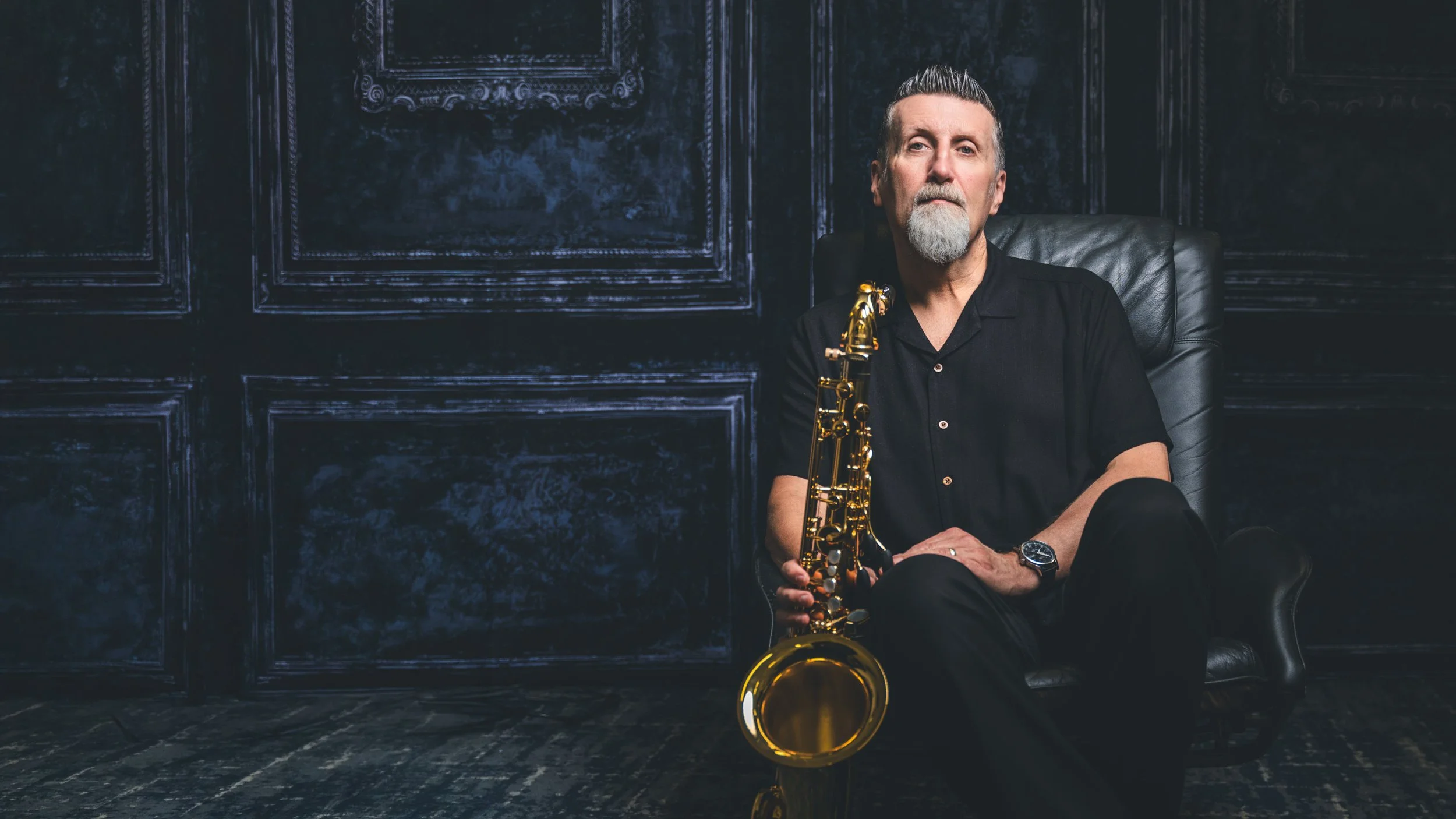
“Music...it’s a life-long journey.”
Website: https://www.dekemcgee.com/
Instagram: Deke McGee Instagram
Date: 19/10/2026
Location: Glasgow. Kirk Lothian Photography Studio
Kirk: Welcome Deke. I can see you have your Saxophone with you. The obvious first question from me is…Why Saxophone?
Deke: Thank you, Kirk. Thanks for bringing me across. Thank you.
I need to take you right back to my 13th birthday there. So, my older brother, Paul, he's a… he played the bass, he was two years older than me. So, on my 13th birthday, I wanted to do something. And my mum and my aunt’s favourite uncle was her uncle Victor, who was a saxophone player. So, my mum’s family were all musicians.
And so, they asked me if I wanted to play the saxophone, but I didn’t know what a saxophone was. So, at the time there was a song in the charts by Billy Joel called Its Still Rock and Roll to Me. And they let me hear the saxophone solo, and it happened to be a kind of rock’n’roll saxophone solo. I just fell in love with the sound.
So, they said, “We’ll get you a saxophone, but you need to go to saxophone lessons.” So, they bought me a saxophone, and they got it from Biggars Music in Sauchiehall Street. And they got me lessons with an old lead alto player from the 40s and 50s called Alfie McLean. And he just started to teach me to read music and to play.
So, on my 13th birthday I got handed a Czechoslovakian alto by a company called La Fleur, which was built like a tank. You could fling it off a wall — I think they made tanks as well. You could fling it off a wall, and it could bounce back and still play in tune. So that was how I started — 13 years old.
Kirk: So obviously you teach saxophone, but you went to saxophone lessons back then?
Deke: Yes.
Kirk: How would you say how you were taught differs from how you now teach? What are the differences? Because musical theory stays the same, but what would you think the differences are between then and now?
Deke: I suppose we all learn from people who have come before, so I probably do teach some of the same method and the same style that I was taught. But the slight difference, and Alf was a great teacher and a great alto player, and looking back now, any time he played everything, he played flutes, clarinet, piccolo, all saxophones. He used to get into his house and there were saxophones and sheet music all over the couches and the seats. But he came from the years of the big band era, so he didn't have any qualifications. He didn't put me through grades. He didn't believe in grades.
When they first taught in schools, they were peripatetic teachers. So that meant they were… it's taken me thirty‑five years to pronounce that properly. You rehearse that before you come in. Peripatetic teachers. So peripatetic teachers they still have nowadays are… in the case of music, they're musicians, they only teach the instrument. They're not music teachers based in the school. They go from school to school. So, they might bring in a flute player. In the morning, you'll be in one school, the next afternoon you'll be in a different school. You're not in the classroom teaching; you're teaching the actual physical instrument.
So, he was a peripatetic — I'm going to say one more time — peripatetic teacher. But Al's thing was, he would teach you, if he was trying to teach you something, he would explain it. And me being 13, a lot of times I didn't take in what he was telling me, but he wouldn't change the way he taught. So, if he was trying to explain something, he would just explain it the exact same way again and again and again. But louder. Until he battered it into you, basically. So not his fault, but 50% of the stuff he taught me went in, 50% went right past me, basically.
But as far as music theory, and I still use some of the books that he taught me, he never taught me improvisation, we didn't get that far. So, I suppose I still teach the same way he taught me, but I've got a certain path that I put the students through. The first thing I teach them is to make sure they're breathing and blowing properly, because the reason I wanted to play saxophone and the reason they want to play saxophone is the sound. So, there's no point having a lot of people think technique — so I suppose the same with piano as well. A lot of people think the saxophone technique is how fast you can move your fingers, but there's technique and sound and tone. So, it's making sure, I try and make sure whether they're playing their least favourite song or their favourite song, it's got to sound nice.
But he used to play, when I was playing “Twinkle Twinkle Little Star” or “Somewhere Over the Rainbow” or playing his scales, his sound was just huge, a beautiful lead alto player. Because I think back in the days when he was playing, there was very little, if any, amplified instruments. So, if he had to stand up and take a solo, a lead alto solo, he had to project his sound over the other 60 musicians on the stage. So, all these old players had huge, huge sounds so he could hit the back of the dance hall.
But also, his lessons were fascinating to me because as a 13‑year‑old kid, he would just wander off and talk about the dance halls he played and who he played with a way down in London, all over the Dennison Palais, the Alexandra Palais down in London. And these names to me became kind of magical and mythical. So, it was more about him talking about being a touring musician and also learning at the same time. And for me that was just a kind of a magical world I wanted to get involved in basically.
So, at the very early age of 13, 14, I did know I wanted to be a saxophone player. But that was like a young kid wanting to be a football player or wanting to be an astronaut. Obviously, I had no idea what I was going to do, it was just a kind of a pipe dream basically. But his lessons were always very informative, and he made it a lot of fun as well.
But when I turned 16, I joined a band and it was all playing by ear. So, everything he taught me, music theory wise, notation wise, I just totally forgot because I wasn't using it. There were no dots on the page. It was just, “There's an LP there, need two songs for next week.” So, your ear developed — my ear developed badly. Not very well badly. But my reading music was terrible.
But he was a great teacher and a great player. The fact that I used to go and see him once I was playing my bands, I would meet him maybe once every two or three months and take him for fish and chips. This is years later. And he was very, very — I suppose I would be as well — he was very, very proud that somebody that he taught, not just me, a lot of people he taught, was now doing it professionally, you know what I mean? As I'm sure I'm the exact same as for my people.
But I say that a lot of people come to me for lessons and it's not just… a lot of people just want to do it for their own enjoyment. I had one guy that came to me years ago for lessons and he phoned me up and he says, “I'm 76, son, and I bought a saxophone.” I said, “That's fine, no problem at all.” So, he came for his first lesson and I was really curious. I said to him, “Do you mind me asking, have you always wanted to play saxophone but never had a chance?” He says, “Not particularly, son. Me and my wife were doing a weekly shop in Lidl. In the middle aisle they were selling saxophones and trumpets. I bought a saxophone.” And all he wanted to do was to learn to read music so he could play the songs that him and his wife used to dance to in the 40s and 50s, which was terrific.
Kirk: What was the first record that inspired you to play blues? Turned you into blues.
Deke: The first record was I went into HMV Union Street to buy Spandau Ballet's 12‑inch record “Muscle Bound” with no saxophone actually. And next day on HMV was a very small pile of jazz and blues LPs, just a very small section. And the blues LP at the front was a multicoloured — it was either on Ace Records or Charlie Records — by a Hammond organ player who I now know was called Bill Doggett.
And it was… they stopped in the middle of some highway in America, and they'd taken a picture of them in front of the tour bus with bass drums, double basses, saxophones. And when I turned the LP round, it was the picture that caught my eye. Turned the LP round, there was “Honky Tonk Part One,” “Honky Tonk Part Two,” “Big Boy Sliding Buttered Popcorn,” I remember that “Rambunctious.” The titles just grabbed me. And when I looked it was all… first 10 or second 10 or first… I thought, “That's full of saxophone players.” So, I'm looking at things thinking, Bill Dog… I didn't know who he was. Or Spandau Ballet’s “Muscle Bound,” if you got that at home, it was just a plain white sleeve. And this is what I thought: I'm going to spend my £1.75, I'm going to take a chance. And I took it home and I put it on, and it just blew my mind.
And I didn't know at that time, but “Honky Tonk Part One and Part Two” was the biggest R&B instrumental in 1956. And all the guys on it, I now know, were all great players, all came out of the big band era, from Count Basie to Duke Ellington. Clifford Scott on tenor and Billy Butler on guitar. They made up “Honky Tonk” in a hotel room, apparently. And so that was the one that turned me on to playing. I wanted to play with that.
And then a week later — actually probably months later, but the romantic side of me thinks a week later — my brother came in with an LP. And it was… on one side was a guitarist called John Brim, who I liked, but the other side was Elmore James. And I'm sure it was either called “Who's Muddy Shoes” or “Who's Muddy Boots,” and a picture of a pair of muddy shoes or boots on the front. And the Elmore James song was “Dust My Broom.” And I put it on and saxophone aside with this slide guitar playing and his voice. And so, between that and between Bill Doggett and “Honky Tonk,” that was me. Spandau Ballet, great band. The new romantic stuff just took a left turn, and I just started to immerse myself in all these great R&B rock’n’roll sax players.
Kirk: What a title for a song though. “Rambunctious.” Rambunctious. Do you know, in Glasgow, you know what it would have been called in Glasgow, that song? What was that? It would have been called “Gallus.”
Deke: Gallus. Well, it was Ram — R‑A‑M — dash, bunk, and then shus was S‑H‑U‑S. I can still hear… talk about growl, the effect on the saxophone is called a flutter tongue. And was the flutter tongue in “Rambunctious”? That's… the whole saxophone is based on flutter tongue. And flutter tongue is different from a growl on a saxophone.
The best way to describe a flutter tongue to someone who doesn't know remember when we were a kid, used to take a nice lolly stick and put it in between your bicycle spokes to make it sound like a Harley‑Davidson. That's what you do. What you do is with your tongue, you drop your tongue — no offence, Harley‑Davidson owners — you drop your tongue and you roll your R’s if you're speaking Spanish. And that gives an effect on the reed that gives it that kind of Harley‑Davidson kind of thing. Slightly more guttural than a growl on a saxophone. Flutter tongue. Flutter tongue on a saxophone. And “Rambunctious,” listen to Bill Doggett’s “Rambunctious,” you'll hear exactly what I mean when you hear the saxophone. Terrific. I can't, I can't do it. That means it's terrific.
Kirk: What would you say to someone who considered blues to be old‑fashioned?
Deke: Wow. This is where you start to fall out with people in the audience. I don't know. I've just always… I can understand why certain people don't like blues, because when they think about it, they think it's just three chords. For example, when I'm teaching people to improvise, as most teachers do — I think most saxophone teachers anyway — I'll give them a 12‑bar blues, because the chords are easy to understand, or easier to understand, but it's not easy to play, as I'm sure you know about being a piano player yourself.
So, I just think… it's been said before, I just think blues music, regardless of whether it's from the 20s, 30s, 40s or the 2000s, it's timeless. Whereas when I said earlier on about new romantic music, you know that's from the 80s. Great music. David Bowie, T‑Rex from the 70s, the Beatles, the Stones from the 60s, even though they're still playing today. But I just think blues is timeless.
So, I don't think… and there's all different types: there's acoustic blues, there's guitar blues, saxophone blues, there's swing, jump blues. But I just think it's timeless and I don't… I think, as I'm sure you've seen at gigs as well over many years, I think some people come to see blues bands and they might not understand what the music is, they might not even give it a title, but their foot's tapping and they want to dance. And I'm not saying you can't get that with other styles of music, but I just… I think without blues music, with the classical music, you wouldn't get any music. Without blues music, you wouldn't get… there's a lineage. You wouldn't get the big band music, you wouldn't get the smaller bands, swing, and then you wouldn't get rock’n’roll, and then you wouldn't get your 60s. So, it all comes from… I think it all comes from blues music.
But I can understand why people think it's quite repetitive, but to me it's just… I don't know, it's ageless, timeless. And it's that connection with your inner self when you're playing any musical instrument. You can lose yourself. In fact, I often lose members of the band. Never been docked yet, never been docked yet. I can lose myself and everyone else.
Kirk: We're moving on to the more serious stuff. Oh dear. Now here, Mr McGee. So. You're sacked. In a blues solo, how many wrong notes are acceptable?
Deke: Well, as my teacher, as Alf used to tell me, you're only ever a semitone out of tune. So, if you play a wrong note, just move up a semitone, down a semitone.
The problem is with a lot of musicians — and I was used to one of them, and I've worked with many, especially in this kind of music — if you do make a mistake or if you want to do an extra 12 bars, you don't let the audience know. Because they always might think something's went wrong. They might not know what's went wrong, but because something's went… just if you play a wrong note, just play a wrong note, just move on.
A lot of times if I play high notes, outwith the range, the harmonic notes, the altissimo notes, and I don't get them, I'll be… I've got to use the word gallus there, but I'll be stupid enough to go back down and hit it back up, so I'll always get that second time round. So, if the audience hear that, they'll know I've made a wrong note, but it should be enjoyment and fun. I mean, sometimes you're good and bad days at work like everyone else.
Kirk: I think if you have the attitude that no one's died here, we'll try it again, or… whatever, we'll just go with it. There's an energy on stage where you can look at each other and shake your head or whatever, and the audience know, and the audience come with you. It's that human interaction where it doesn't even matter. We're having a good time out there; you're having a good time out there.
Deke: I think most people make mistakes on stage. I mean, it depends. It's how many mistakes and how many songs, and they say you make the mistake and then we need to talk, because I mean… you just need to talk to me. But no, it should be enjoyable, it should be fun, and because it's… as I say, if somebody's… if there's a 24‑bar solo and you're having a ball, take another 12 bars. I mean, that's the beauty of this music, basically. Yeah.
It's that we've all played with different bands. I've played in bands where, like certain tribute bands you play in, and understand the audience is there, and the audience know every single lyric, every single guitar notes, every single saxophone notes, and that's what they paid money for. So, there's no point me improvising a solo that they want to hear the exact same solo. And a lot of these solos are now integral parts of the song, so they've paid their money, do what you're asked to do.
But in our style of music and our songs, you're free to do… there's certain parts we all play, but in the solo, knock yourself out, you know what I mean? That's why we want to play music. Yeah.
Kirk: So, and that's when it's improvised, but we… sorry, I know what's coming. I'll strap myself in. I'll strap myself in. But with some songs, there's definite breaks or… you need to conduct the band in a certain way so that everyone moves at the same time. So, when you do that, do you move your arm up or do you move your arm down?
Deke: As you're well aware, there's one of those songs that finishes and it's on my cues. So, every time we've done it, I've cued you down, the band stabs. For effect, I put a wee pause in, I cue it at the end of the band, and for some reason that night I did do that for the tour, rather than that, and you must have thought, “What the hell's going on?” But I will never do that again. Please don't. Never do that again.
So yeah, sometimes even the band leader gets it wrong. Yeah. The audience were well aware of that. But in that situation, you need to laugh about it and just… as you say, the audience comes with you basically. But I will never do it. It's always down, down. Note to self, never down, up. I'll never do that again.
Kirk: You've travelled. Well, you've done the Montreal Jazz Festival, you've played all over the world. You've played with some amazing musicians; you're an amazing musician yourself. If at some point you considered writing an autobiography, what would you call it?
Deke: I think most musicians you meet — I know for a fact all musicians you meet — have got wonderful stories. It's just… it's just that part, it's just… I don't know, just this… do you want to call it a job or career, but this… you meet characters. What do we call them? I haven't even thought of that. I never would anyway, because I wouldn't think it's that interesting.
But when you hear… it's funny, myself, my wife Donna — there's been a name check for you — we were actually out yesterday and we were talking to… it was a couple at our wedding. And they were asking about musicians and stories and they were talking about… they'd been to Canada and they happened to stop at the Montreal Jazz and Blues Festival. And it just shows you… I'll tell you a quick story if that's okay.
The reason… I was playing with a band called Big George and the Business and they were playing a really — nothing against Blantyre — but a really rough pub in Blantyre. And I think there were about seven people in the audience and five of them were the band, basically. And there were two guys standing at the bar. And this is for all you young musicians out there. Two guys standing at the bar having a pint.
And at the break we went over to get a drink and two of them — one with a Scottish accent and one with a kind of Scottish‑American accent. And the guy was called Alan Patrick and he's from Blantyre and he stayed in Canada. So, he got talking and this was him. He came back to see his family in Blantyre and his brother was standing beside and his brother said, “Come on, we'll go for a pint to the local pub.”
And we just happened to be playing in the pub that night. And he turned round and he says, I love the band. Well, not to me, to George. He says, And I'm a booker for the Montreal Jazz and Blues Festival. And you're sitting thinking, Yeah, sure you are. So, he says, I'd love to bring the band across to play at the blues stage, Labat's, Labat's beer at a blues stage next year. Can I get a phone number?
You're sitting thinking you're playing a pub in Blantyre, nobody's interested apart from you two at the bar, and you just happened to be a booker for the Montreal Jazz and Blues Festival. So, three weeks later, George gets a phone call, and true to his word, he was a booker, and he brought the band across for two weeks.
And that gig that we played at the outdoor stage at the Montreal Jazz and Blues Festival, I mean, I don't know many people, there was thousands of people outdoor stage, and it was Labatt's beer sponsored it, and it was just wonderful. And right after that, we played there, I think about, say it was 9:00 to 10:30 at night, and a minibus came and picked us up and took us to a place called the Spectrum Theatre, which is like the size of the Barrowload here in Glasgow, for a 1:00 AM in the morning show.
Amazing. So, you're sitting thinking, you're twenty‑three, twenty‑four, you've played in front of how many thousands open their stage, and now, and the reason I thought it was so professional was because you went into the dressing room and there were towels. I don't sweat on stage, I thought, please, I'm taking one of them on stage, which is 'cause I thought that's what you did, so you never know who you're playing in front of them, so that was a really...
I can't remember what the pub is called, but a wee small pub in Blantyre, the guy in the audience was a booker of Montreal Jazz and Blues. So, if we'd have just turned up and went, there's only two people, let's just. But George was full on from start to finish. And that led to years, maybe three or four years, every year going back for a longer period of time. You meet more people there.
But as far as what I'd call my biography, I don't know, lucky. Chancer?
Kirk: Chancer's good. From Blantyre to La Batts?
Deke: Yes, I saw that night, I mean, I was playing with, as I say, the band Big George and the Business, and George was a, as you know, George was a great guitarist, a character on stage. But if we'd have just turned up there and thought, it's just a beep up in Blantyre, or if the band wasn't good, he could have just been having his pint and just never been interested.
But the fact that George just took the show to whoever he was, and George made it easy, certainly easy for me, because George was like 6 foot one, he'd a 24-inch waist, very, very thin guy. He used to come out with a pair of, here's stories for a biography, his Auntie Betty used to buy him a pair of Levi 501s and have to take them in, so a size 24 waist.
So, he would go on stage with a pair of 501s, cowboy boots, nothing on top, half a pair of braces, hair and a cowboy hat. So, the audience thought, Wow, this is… and I remember walking on stage that night, the outdoor stage, and he just, from the first note he played guitar and sung, the audience were just in awe, so it made our job a whole lot easier. Certainly comedian, because I'm walking and I'm really nervous, you know.
So, George just… George ended up, was it that, was it that time or the time after? In the Spectrum Theatre, the after‑hours show, he was on stage with Buddy Guy and stuff like that, Buddy Guy, Robert Lockwood Junior, who was Elmore James’ stepson, I think it was, and he just held his own, no problem at all. With Buddy Guy. Held his own, he was, that night he just, he was on fire, tremendous, you know what I mean, but he was just loving the fact he's on stage with, to him, all these legends, you know, but he wasn't a shrinking violet George as well, you know what I mean?
So as far as… but most of the stories I would put in my biography would be about things that I kind of witnessed and was lucky to be around, you know what I mean? But you're right, it's the right place, the right time, but having enough knowledge of music and enough practice that the right place, right time, so you'll get the job. No point in right place, right time if you're rank rotten.
But the stuff I've recorded, I'm just saying, most musicians… the stuff I recorded 30 years ago that if somebody said, Is that you? I would say, No, I would not own up to. You know what I mean? So, it's just a lifelong lesson you're learning all the time.
Kirk: I think anything you're passionate about, anything that is stuff that you can't not do, you know, you couldn't put music down, and if you did, you would pick it up again. I'm the same with music and the same with photography. I just can't, you can't put it down. And that, when you have that attitude, you keep learning, you keep learning. It's never done.
Deke: Well, there's things, I've been playing, I'll be forty‑five, forty‑five years, sorry, forty‑six years this year, I've been playing the saxophone. I mean, that's a long time to do anything. And there's probably a lot of things, I mean, I had jobs when I was like 16, 17, 18, 19, but I remember George, asked me, I met George, Big George, during the Mayfest festival in Glasgow, which is 100 years ago.
And after playing again really badly with his band, he asked me to come along on a Tuesday and record on one of his, a track on his album. And I along recorded, and what I thought, looking back now, was probably not that good, but it was on the CD on the album.
On the Thursday, they asked me to join a band, so I had to go and, because of a travelling tour in the band, I had to go and see my mum and dad on the Thursday, Thursday night. I've been offered a job with a band, but it's full time, so I need to give up. I hate doing this. My day job, know what I mean?
So, but my mum and my dad came from musical families. So, at 19–20, they said, no problem at all, go for it. Because obviously, had them to fall back on. But because they came from musical families, they didn't say, no, you need to just forget that. I should have piped them.
So, with their backing, next day I think I was in Europe somewhere, and it was like 10 years of travelling and touring. And for a young boy, that's… I mean, I remember going to Montreal with George the first time. We turned up at Glasgow Airport. I can still remember this. We turned up at Glasgow Airport with £10.76. Between us, five of us, £10.76, but we're going to Montreal for a month. £10.76, and that gets spent at the bar, but you know, two things.
At the airport. At the airport.
But two things: you know that you're going to get taken care of when you get there. And the second thing is, you don't care. You're young and you're daft, just like five pals going on holiday. And as you say, you're playing music.
So, there's probably a lot of things over 45, 46 years that I would have liked to have even attempted, that I might have been okay at or terrible at, but nothing's came for me, nothing's came close to playing the saxophone, nothing at all.
And to have… so I suppose it's like a kid going to be an astronaut or a trapeze artist or a footballer, and I've been lucky enough to make a living that I play music sometimes, not making a living. No regrets at all. No regrets whatsoever.
It's been, and you meet, as you know, you meet so many interesting characters, both on stage and off stage. And it teaches you, as George always taught me, if you're friends off stage, on stage just works. And that's why you say about playing wrong notes. Who cares?
I know. It is a community. That's what I'm doing with this. I'm trying to highlight how much of a community it is, how many different people there are.
But you pointed at your saxophone there, and this question just came in my head, like B.B. King. Mm‑hmm. He called his guitar Lucille. Do you have a name for your saxophone?
“Oh, oh, oh. No, I don't. I don't actually, because, well, because I was always of the opinion, and this, sorry saxophone players, it's just a bit of brass.”
Now here's why: the saxophone — don't understand this — most saxophone players, when you change saxophone, if you do change saxophone, a lot of saxophone players will keep the mouthpiece because you and the mouthpiece really create the sound before it even gets into the neck. So, all this does is amplify and change pitch. The sound gets shaped in here through you.
So, you can… it'll be different ergonomically how it feels under the fingers, but…
For about 35 years, I was an inverted snob with saxophones because I would not buy anything new. It was always vintage because the romance of all the players I listened to, you would buy all the… they would buy the same saxophones that played in that track, played in that track. And it's a lot of nonsense. It's you as a player that's creating the sound.
But even the saxophones from the heyday of jazz and blues, they were all, stupidly, you didn't think, they were all new saxophones at the time. But you would still be buying this.
So over 35 years, I had every vintage saxophone ever made. But I didn't have them all in one go because I couldn't afford it. So, I would buy one, fall in love with it, and then fall in love with it, sell it and buy another one. So, all the great vintage makes. And if I still had them, I would have some collection.
But then, I suppose it's the same with pianos and keyboards and guitars and drums — engineering moves on.
So, for the last 10 years, I've been using Yamaha saxophones because they're just great workhorses. So, I don't have any particular individual names for the saxophones. I just call them the boys, I mean, just call them the lads, know what I mean?
So no, I don't. I do — if I had to give the saxophone away, which I don't, I love playing the saxophone — would I be really upset to give them a saxophone? To me, I'm a bit, I'm a bit like Trigger’s broom, owning the folding horses. He's in the same room for 17 years, but eight different heads and 20 different handles, you know what I mean?
So no, so I don't get to… mouthpieces are different, but I don't get to attach to the saxophones, because I know it might boot the door soon. But these ones have been here for the last 10 years, and they do cost quite a lot of money, so I don't envisage buying anything else, and polishing and getting repaired, so that's okay.
Kirk: Do you know that there's actually… it's a philosophical concept and I can't remember what it's called. I'll put it up here. But it is connected to Trigger's broom. So that concept of the everlasting broom is an actual philosophical concept. But I'll put that up there and then we'll move on.
Deke: Right, what's coming next? Hit me up.
Kirk: Right. Favourite saxophone player and why?
Deke: I don't know. There's far too many. Far too many.
When I first listened, if you want to learn to play rock'n'roll saxophone or rhythm and blues saxophone, the best advice I can give you is play along with Fats Domino or play along with Little Richard. And when you start to listen to these players — obviously, Fats Domino has a lot of great piano players — but I was interested in the saxophone players who are all New Orleans and Memphis and Texas and Chicago session players.
People like Lee Allen, Herb Hardesty — they were all on Fats Domino's stuff — Plaz Johnson. So Plaz Johnson, everyone's heard Plaz Johnson. Plaz Johnson played the Pink Panther. Did he? He was a session guy in Pink Panther, but he also played with the Wrecking Crew, who were the studio musicians in the mid‑60s to late‑60s that played on all the Beach Boys stuff. They were studio musicians. Bonanza TV programme, The Odd Couple.
So, they would make more money just staying in the studio, 9 to 5, Monday to Friday. So Plaz Johnson played… he played on Boney Moroney, The Pink Panther, The Odd Couple, Bonanza, as I say, and loads and loads of rock and roll saxophones as well.
Sam “The Man” Taylor — he was a big guy in New York. King Curtis — he was a musical director. So, all these guys, just far too many of them.
Modern saxophone players — people like Greg Piccolo, A Roomful of Blues. I'm trying to think… there's so many people. But Johnny Hodges, Ben Webster, all these old swing big band saxes — there's too many, too many to pick from them.
What I used to do is, I used to — and I tell my pupils this — I used to listen to maybe one or two, one player maybe once every two or three weeks, and steal loads of ideas off them. And then next player, two or three weeks, and steal loads of ideas off them.
And what I find with me personally, all my students as well — if you just listen to one particular player, you become just like a kind of… you plagiarise that player too much, you become just like a poor fashion airplay.
But with me personally, if I listen to that player and steal, and that player and that player and that player, I'm also adding loads of my ideas as well. So, you start to — strangely — because you've listened to so many players and learned off so many players and borrowed off so many players, and put together your own way, you create your own signature style, because you listen to it.
I suppose it's like… it's like, I don't know, Maradona must have watched Pelé, Van Gogh — that means they've all got their own style, but they've all got people that came before them. So, the more players I listen to, I would develop a more sound of my own style.
But there's… I mean, there's a great sax player who's a pal actually, a guy called Joe Sublet, who's Taj Mahal's sax player. He was in Stevie Ray Vaughan's first band, The Cobras. He played with the Stones. He's just a working musician that just… he's played with loads of people — Bonnie Raitt — but his style and his sound are all based on the players that I think you should be listening to, if you like the style: King Curtis, Plaz Johnson, Sam “The Man” Taylor.
And it's interesting that they'll play on thousands of records, but you'll go and find their one or two, their own CDs — it's just saxophone.
So, I always tell my students: don't just listen to a record or a CD where track 10 has got a saxophone solo. Buy CDs and buy records and download stuff — it's the saxophone players in focus. Because you're going to start to bleed into your own playing, and you're going to start to hear saxophones more in songs because you're starting to play the saxophone.
Obviously, the piano players, but there's just too many to pick from. If you ask me that tomorrow, I'll tell you 20 different players basically, but there's just too many great players.
But jazz — jazz side of me — I like the old kind of big band, the people with Count Basie and Duke Ellington, Johnny Hodges, Ben Webster, Lester Young, Coleman Hawkins. I've got Charlie Parker records and CDs at home, playing earlier played like Jamie Shannon, the piano player in the big band, playing wonderful blues stuff.
And Charlie Parker and John Coltrane — they're wonderful saxophonists. But the problem I find with a lot of teachers — I'm going to get blacklisted here — the problem I find is because they listen to Charlie Parker and John Coltrane not only, but they'll give a young kid a Charlie Parker CD or a John Coltrane CD, and they're either going to inspire the kid beyond belief or put them off playing.
So, you need to kind of — me included — open new ears up to new things as well, modern‑day players as well, that's going to bring the kind of new players on as well. And myself, I'll steal off anybody. If it's good, I'll steal.
So probably about 30% of the stuff I play, I've made up myself. The other 70% I've borrowed off other people, but I'm now singing it my own way. As I'm sure you do the piano — everyone does it. Anyone that says they don't is talking nonsense.
Kirk: Here's something — let me put this as a concept to you. All of those people, all of these players — they're just ingredients with which you make your own cake. You say potato, I say potato. That's true. I would just call it… these are all the bits and pieces that your brain brings together, puts it in the mixer, and it comes out you.
Deke: Well, many, many years ago when I got called for a lot of recording sessions, it was different. It was different. It wasn't just all blues stuff. There was reggae stuff, there was ska stuff. So, if I knew we were doing a gig with a band or a recording session, I would have ska music on that whole week — make my breakfast, have my dinner, come out of the shower, whatever it was — I would have that style of music on, because I knew at the weekend I'm playing that music. And it just started to digest it.
I did a recording session once in a studio down beside the barracks — can't remember what it was called — and it was just me, myself, and it was with Toots and the Maytals. Toots and the Maytals, a big reggae band. It was their horn players were in town, and they wanted to do some recording. They weren't there — they put the recording down the day before. I think they were playing the Barrowland that night.
And they needed another sax player to come and do the second tenor parts. So, because I knew all that week I would listen to Toots and the Maytals records — which is wonderful stuff — it wasn't the stuff I'd normally listen to, but it was great music. And again, a lot of the Jamaican ska stuff comes from early rhythm and blues music as well.
So, I listened to that all week so that my mind was in the right kind of mindset to play along with them. And when I got there, I thought I was going to play along with them. They'd done it the day before, but they were away with somebody else. So, I just tuned in myself, just playing along with the track the day before.
So, it's listening to… if you're going to play — and that's what gets me a lot about people saying they're session musicians, especially very young musicians — “session musicians.”
A session musician to me is somebody that goes into the studio in the morning and plays like Charlie Parker. In the afternoon they're playing Beethoven. The next day they're playing pop stuff, because they can do it. They've studied all this stuff.
Modern‑day musicians, especially very, very young kids — and I think I used to do it myself as well — you'll see they're a session musician because they play in two bands. But the two bands are playing the same style of music. You're not a session musician — you're a musician that plays in two bands.
But I think I used to do that myself as well, because it makes you kind of feel as if you're a very experienced working musician. But a real session musician will play pop music in the morning and play Beethoven in the afternoon. They'll do an improvised solo by ear, learn that by ear. They'll play dots in the afternoon. That's a proper session musician, in my eyes. I might be totally wrong.
But then I'm going on for six doing what that means.
So, if I was starting again, I'd say I play in three bands, I'm a session musician. Because my auntie would think that would sound great, but there you go. Just my point of view.
Kirk: Sometimes you phone me up when you're walking the dog. And you're in Bellahouston Park sometimes, and you've got your phone and you're like… and you go… and this is the rhythm. And then you're humming and you're whistling and you're singing and you've got some words.
Deke: But that's by the by.
Is there something that comes first? Is it the melody, the tempo, or does a phrase come into your head? Typically, what is… how do you write songs? What is the…
Well, I do write most of them, as you did— say, the first person to hear any of my song ideas is my German Shepherd, because most times if I'm in a cemetery or in a park, if he's got away for a wander, I'll just… an idea will come in my head. And again, I suppose a lot of people write a song. I really don't know where that idea comes from. I really, without sounding airy‑fairy or spiritual, but I remember Keith Richards. He's probably saying in the interview that all the songs are just floating about up there. He just puts his hand up and pulls one down and then develops it. Now, whether or not you believe it or not, I don't know.
So, I don't know where ideas come from. Melody‑wise, it's always melodies with me, because I find writing melodies very straightforward, and I know how that might sound, but my job as a saxophone player is to play melodies. So, if somebody says to me, write a saxophone player, take a solo, I'm playing a melody. If somebody says write a horn line, I'm writing a melody. So, I've done that for 45, 46 years. The difference now is I'm putting words and lyrics to the melody.
But every single song that's been written — every single song that's been written — is somebody's improvised idea set to a repeated pattern. So, you think of any song: somebody's had to come up with an idea, whether it's instrumental, whether it's got lyrics, and then so that Joe Public can whistle it walking down the street, they'll do it to a repeated pattern — verse, verse, mid‑late verse. That's why a lot of Joe Public, as I call them, don't like modern jazz, because the song starts, then the soloist goes off working with the chords, and they can't hear the melody again.
Whereas popular music, pop music, blues music, all styled music — there's a repeated form. So, verse one and verse two might have different lyrics, but it's the same melody. So, the melodies I write, I've been writing melodies on saxophone for all these years because I've had to take solos. So, the melodies to me come first, and they might just be two or three notes.
It's the words, it's the lyrics that I need to take more thought about, because lyrics for years have been a soloist without any words. So, I need to take my time writing lyrics or think of an idea that I can write about that I've not wrote about before — or everyone's wrote about something before. The melodies come really, really straightforward to me.
So, it might be on, as you know, maybe on my phone — I've got an idea, just hum it or whistle it. So that's why in a cemetery it's quite good, because you're walking down a cemetery just singing while your German Shepherd's walking beside you.
And then I might listen to… so out of maybe five or six ideas over maybe one or two weeks, I might have — I'll go back to, okay, that's worth taking a second look at. Then I'll come back home and sit at a piano — basic, me playing basic piano — and start to kind of create a certain form.
And as you know, I use what I call a style clip. Because it's here for me — if I've got a rough idea of how I want the song to sound, I'll find something that's in a kind of similar style and just send it out to you all so that I know when you come to rehearsal, my words are almost 60% there. Then when I let you just hear it, you still bring your own parts to it, but it's… for me as the main songwriter, I still find it quite nerve‑wracking, because coming to — even though we're all friends and I've played in bands for years — I still find it quite nerve‑wracking coming and saying, “Here's my idea,” not even “What do you think?” but it's that kind of…
But I know if you all kind of come on board within about 10 seconds of you hearing the stuff, I know the song's okay enough to move forward with. But nine times out of ten, I'll know myself whether it's worthwhile taking to the rehearsal room.
For those of you who don't write songs and don't come to a rehearsal room and don't stand and do it — try it. It's real. It's nerve‑racking. But you're also putting your heart and soul out there for them to say, “This is it, what do you think?” You know what I mean?
So, it's a… I mean, we were out there all night, and where we were, played two of their songs, and I was… I actually turned my seat away and just kind of sat with that, because for me — I mean, it's lovely that they played the songs, and its lovely people enjoy the songs — but I still find it quite… I don't know if embarrassing is the word, no, that's the wrong word, but I still feel as if I'm not kind of… “I wrote that” type of thing. It's sort of that kind of… maybe it's like a Western Scotland thing — “Is that okay?” type thing. “Is that song passable?”
But some of the people I've been lucky to work with — especially George. George taught me a lot of stuff. George used to… he used to just… he would turn to the bass player like a piano player and just say, “Right, G to C, just two chords.” And he would just start playing G for two bars, C for two bars, and just write a song on the stage.
And when you're a lot younger and you're watching the main guy in the band doing that — with all these beautiful lyrics — and you're trying to put something to that as well, the songs he wrote to me were just massive, and just beautiful, beautiful songs, but most of it on the spot.
Kirk: Really? On the stage.
Deke: I remember playing a place in Glasgow once. And he did that — and talking about dogs — he used to bring his dog to the gig. He had a dog called Coal House. Coal House. Coal House. Coal House. I can still see it. It's just a wee mongrel.
And this particular gig, he brought it. He's talking about biographies — he brought it to the gig. And it used to… remember in some pub, you used to get a big, huge ashtray, big glass ashtray. The bar staff would fill it with water, and they would put the ashtray at George's mic stand.
Kirk: Oh, nice. Electrocution.
Deke: And the dog used to just lie at George's feet. I mean, the audience loved it as well.
But George — he'd done this song one night called Fossil Grove, which is a place in Whiting Park. And he just turned to this band and said, “Just G and C.” And he just started with guitar to give us an idea. And after about five minutes of George singing and the band, it was like the song was getting composed as he was writing it — as he was doing it, sorry.
And he turned to me and says, “Take a saxophone solo.” So, I'm taking a saxophone solo over these two chords. And I could see the audience not looking at me — and looked — and George… I turned round and George had his guitar off and he'd put his coat on and put the lead on the dog and walked out.
And you're sitting thinking, right, okay. I'm blowing a lot of nonsense. And the band are still playing, and the audience are all just looking at the door, because he's walked out with the dog. And the band are still playing.
Thirty seconds. One minute. Two minutes. Five minutes. He's still not back.
So, we're all — I have certainly experienced something — just keep playing. So, the audience are watching the band now, and all of a sudden, the audience… obviously he's come back in with the dog. He comes back in with the dog, and it's something in his hand.
And back on the stage — took the dog, laid down at the mic stand again beside the ashtray of water. He took his jacket off and he took the dog next door for a sausage supper. And he came back and I physically watched him breaking up the sausage supper, putting it in the microphone stand for the dog to eat.
Guitar back on — “Okay, I've got it now.” And away he went.
And the audience are just sitting like that.
So, to have the kind of swagger to leave the venue, buy a sausage supper for a walk, bring it back in, and the band are still playing… stuff like that sticks in your mind. But George — he could do that on the spot, he could do that in his house, do it anywhere — just write songs on the spot.
So, you learn a lot from people you work with.
So, for me writing songs… but I still — he wasn't nervous — but I still get nervous bringing my songs to you because you're maybe… rubbish, you know what I mean? But it gets to a stage where I now know if the songs are worth taking forward or whether it's… so maybe the five or six ideas out of that one will evolve into something, and then you all come in and bring your own personality to the song basically.
Kirk: Do you still get nervous before a gig? And if you do, how many songs does it take or how many notes does it take for that to vanish?
Deke: I’ll tell you what… I still get really nervous — but I'd say that's a lie. I don't get nervous now, but when I first started — I use this term loosely — when I first started singing, that was really nervous.
I remember the first time I sang, because obviously I played for many years as a saxophone player, and I'd done the occasional backing vocal, but still not lead vocal. And I remember the first night I went to sing just in a wee pub in the west end of Glasgow, and it was quite busy.
And I remember turning to the drummer at the time — my first gig singing — I said, “Okay David,” a guy called David Stone. I said, “Right David, count the band in.” And I went to pick up a glass of water, and my hand was like that. And I thought, what the hell is that? And it's because I was doing something way outside my comfort zone.
But the one thing that still gets me nervous — not so much singing now — but makes me nervous, is talking to the audience, communicating with the audience. And when you see some really great front men — singers, guitarists, saxophone, whatever it is — there needs to be that… it helps if there's that communication between the stage and the audience, and there are some people that are wonderful at it. So, it's that kind of talking.
I remember saying to my wife Donna after the first night — because you can't just… certain acts do, certain artists will just… song stops, next song starts, song stops, and there's that silence in between — but there's got to be some communication. Also, sometimes the audience want to know what the song's about. Sometimes I want to do that as well when I'm going to see a band.
But I remember saying to my wife after the first night of doing it, I says — and I suppose it's comfort and you're talking to your wife — I says, “How did it sound in between? Not the band — how did that sound in between talking to the audience?”
She says, “What do you mean?”
I says, “Well, when I was introducing a song, to me it was like, ‘Good evening, folks, how are you doing? Thanks for coming in tonight.’ Sounded like Mickey Mouse, you know what I mean?” And here, I thought that sounded…
And she said, “No, doesn’t sound like that at all.”
And then… but to me, I still get nervous. Not trying to make it interesting, but enough of talking to others to cover that gap between that song finishing and that song starting. And that's just me — that's just who I am basically.
So, when I'm behind that, I don't get nervous at all. Maybe it's true because I know what I'm doing on that. I mean, obviously we're all still learning, but I know enough that that's my security blanket.
And if I take you back to the Montreal Jazz — sorry, take you back to that — was the first night I used a clip‑on mic. The guy said, “What do you want? Do you want a clip mic, or do you want a mic and a stand?” And I know it sounds daft, but I'm mic and a stand. That was my behind. You couldn't see me because behind that microphone stand — the mic behind that — I was invisible, aside from me doing the talking.
But the clip mic — I felt totally naked because there was nothing in front of me. So, I could walk over there, I could walk over there, and that took a lot of getting used to.
But the fact — talking to the audience for me — that's the more nervous thing I get about. But it's also making sure the whole night goes well as well. The set's running okay, everyone knows when to come in, when not to come in, how many wrong notes to play in a solo, all that kind of stuff. And it's making sure the audience are enjoying themselves.
So, it's more about the whole show from start to finish rather than me getting nervous. Because we've all played the songs enough, the audience know most of the songs anyway. It's making sure the whole night goes and they have a good time; we have a good time as well.
That's once it's finished—…but you can tell, you know yourself when you're playing a gig, enjoying it or not, basically. We've all played gigs; the audience have known what to avoid basically. So yeah, I still don't get nervous, but mostly about the actual communication aspect with the audience and what to say. But you need to do that, otherwise it's just song after song after song — there's got to be some bridge between the audience and the stage.
Yeah, you need to bring them in.
Life and Music Intertwined
Kirk: If when you were 13 years old someone had said to you, “You're going to have an enormous amount of fun. You're going to make a lot of really good, lifelong friends. You're going to make a living out of this. You're going to feel self‑fulfilled. Thousands of people are going to look at you and applaud what you're doing. All you need to do is blow into this metal pipe.” What would you have thought back then?
Deke: It’s an amazing… music is such an amazing medium. Looking at the saxophone there, the number of things that that has brought into your life is amazing.
Well, yeah, I mean, it has. Again, to some people this may sound kind of airy‑fairy, but I suppose it's like anything you do — it has shaped my life. Amongst many other things. But if somebody would have said that when I was 13, I would have thumbs up, I'm going to grab that. I would have thought maybe there… I would have known when I was 13, but for these old eyes, I would have thought, “No, you're having a laugh at that, that's never going to happen,” you know what I mean?
But it's been — as with many careers, especially music as well — you don't get these jobs down at the job centre. It's not 9–5 jobs. So, there's a lot of sacrifice, a lot of highs and a lot of lows, amongst other things as well.
But yeah, I suppose it's kind of shaped my life the way of… I'm sitting here now talking to you about it, 45 years later.
And I never ever thought I would teach, because if anybody ever asked me to teach, I would give them my teacher's number. One, because I wasn't interested, because I was away travelling, being a daft boy. And also, I didn't know — I didn't even think I knew enough to teach. I knew what I was doing on it, but I didn't know how to put that across to somebody else.
From my first day of teaching to now, how I'm teaching is totally different, because I've learned over the last 25 years. So, I've learned so much over 25 years of people coming to me, how I structure my lessons. So that's also shaped me as well.
But I'm very, very proud — very, very proud — that from the age of 20–21 up to the age of nearly 59, I've made my living low and high enough, and I've paid all my bills and bought houses and paid my bills and had a family because I play the saxophone.
Because a lot of people, I think, when they think musicians, they think just… and some of them are, some of them are… are just fly‑in and fly‑by‑night, and it doesn't mean that you need to make a living. I know loads of musicians who are great musicians, but they just do it as a hobby. So, it doesn't mean you need to do it for a living, but I never thought I'd get a chance to do it for a living.
But if I didn't teach, would I have had to do something else? Probably. Because to make a living out of music — especially playing the saxophone or not being a singer at the time — you need to go away and travel and tour an awful lot.
So, while I was away travelling and touring when I was young — 20, 21, 22 — the guys, my pals I grew up with, they were all buying houses and getting engaged and getting married. So, I missed out on all that. But I had no regrets about that at all, so I would come back and talk to them about it.
In my life, away travelling across Europe and North America, they had steady jobs and stuff like that. So, they chose that life, which is great, and I chose my life.
All things come in your life — you meet people, you fall in love, you start a family — so you need to… what I learned from playing the saxophone, to do it for a living: you need to screw the nut. That's a Glasgow term — screw the nut. You need to… it's something you sit and think, you need to know what you're doing, or you need… it's like any other job, you know yourself, you need to turn up on time, you need to be rehearsed, you need to be decent or you don't get asked back.
And I guess the interesting thing about music and other arts — as I said earlier — it's not something you can really control. That passion. In other jobs, people might be looking forward to winding down when they hit a certain age, but we're still learning as musicians, and we don't know where we're going from here, but it just feels positive. It always feels that there's somewhere to go.
I remember seeing an interview once with Paul McCartney — I think it was for Rolling Stone magazine. An interviewer asked a genuine question: “So do you ever think you'll retire, Sir Paul?” And he wasn't… I don't think he was flippant. He wouldn't have been smart. He genuinely said, “Retire from what?” Which I think is wonderful.
I mean, obviously there are certain jobs — you couldn't go and tile the roof at 75. Maybe you could, I don't know. There are certain jobs that have a shelf life. This isn't one of them.
The majority — well, not the majority — but a lot of people retire and then try and do this. Or try and play the piano. “What can you do when you're… I'm going to learn piano; I'm going to learn guitar.” He was 76 and bought his saxophone in Lidl. Do you know what I mean?
So, I don't think… and just because you play an instrument doesn't mean you need to be on stage playing it. So, you could still be playing your saxophone. My old teacher, Alf — I'm sure Alf was teaching into his late 80s. He didn't need to, but he had enough pupils that just kept him active. He still enjoyed teaching and passed on his knowledge and kept his brain working. Do you know what I mean?
So, I'm not saying I'll be teaching in my late 80s — you never know — but I don't plan on stopping. I mean, I don't plan on stopping playing either. But whether that's further afield or whether it's local, I don't really bother anymore.
The Future
Kirk: So, what is the future then? Where are we going from here? What's the next steps?
Deke: Is that because you play piano in the band? You want to know?
Kirk: I don't care. I'm happy just doing what we're doing. As you know, we brought an album out in June. The next steps are to… I just… I know how I feel when — not just our band — but I hear this kind of music, and the joy it gives you to listen to other bands playing it. And I know this band and the musicians in the band and the music we put in is… I just know there's audiences out there that have not seen the band yet that are going to enjoy that music and enjoy the band's performance.
Deke: It doesn't mean everyone will, because music's such a subjective thing. You can… I've come off stage sometimes and sit and think, “I thought I was okay tonight,” and somebody says, “I've heard you better.” I think, wow. And other times you can come off stage and think, “You were tremendous tonight.”
But music… that person will think you're terrible, that person will think you're great. That's what music is.
So, I'll just keep playing until… as long as my health's here, great, I'll just keep playing. I'm sure you will as well. Whether that's in front of a festival audience in Belgium or a gig in Glasgow.
I'm getting to the stage now… I used to have a band years ago that a lot of the guys played in so many different bands, and the guys in the band — looking back now — they were just trying to fill their diaries because they had families, they had work, they had bills to pay. I totally understand that.
But I would end up booking guys because they were booked so far in advance, I could never get them to play. So, it meant they were all away playing with different bands every weekend. I was sitting in my house doing nothing because my band wasn't working.
And I got very well-rehearsed — I don't mind saying this — I got very well-rehearsed at being in a bad mood and being angry. And looking back now I realise they were just trying to… I wasn't first — they were just trying to keep the wolf from the door, pay their bills, and great.
So now I've got to the stage where if I try and book something — rehearsal or gig or anything — and any of us, me included, can't make it, we just re‑plan. No big deal. Because it's a first‑world problem. Do you know what I mean?
It's not… as you say, we're still going to go into our houses at night, we're still going to close the door, the heating's on, we're going to go to bed, we're going to wake up, the next day's going to start. So, it shouldn't be a major issue. That's my take on it.
Perfect. Get a job in music, folks. Cool lot of fun. I'm a hundred and two.
Kirk: That was a pleasure. Thank you so much. Thank you so much for agreeing to be part of this Glasgow Blues TV shenanigans.
Deke: It’s a great thing you're trying to do because there are so many musicians out there that have got great stories.
And again, you're talking about the biography thing. I don't know any musician that couldn't make a great biography. And it might not necessarily be all about them, but they've been in the vicinity where something magical or something crazy has happened here.
So, the fact you're trying to do this and document it both online and both to video — more power to you.
Kirk: Perfect. Thank you very much.
Kirk Lothian Photography Studio
Camera info
Camera: Sony A7V
Lens: Sigma 24-70 2.8
Focal length: 38.7mm
Exposure: 1/200s @ f2.8 ISO 100
Time of day: 19:52
Conditions: Exterior, overcast
Lighting: Video lighting
Deke mcgee
Singer,songwriter,saxophone player